
WELCOME TO HEAD & NECK ROBOTIC SURGERY
Advancing minimally invasive surgery with cutting-edge robotic systems for safer, faster, and more effective treatments.

You don’t need to look for the latest robotized hospital in China. AI is already everywhere, transforming even the most traditional healthcare systems. Let’s take a look around.
From Generative AI to Real Clinical Impact
Recently, I used @Perplexity in Comet to refine one of my current projects (how to improve an ENT Department). This is probably the easiest and most obvious way to integrate generative AI into our work. Depending on your level of expertise, it may simply organize what you already know—yet it still helps structure your ideas and sometimes offers an unexpected spark of innovation. Even in these basic uses, AI saves us an enormous amount of time.
The Frontier: Autonomous Surgery
For surgeons working at the cutting edge, our true frontier is autonomous surgery. Here, AI has changed everything (see my previous post on Machine Learning and Surgical Robots).
From real-time image analysis to intelligent assistance systems, the technology that once seemed futuristic is now part of our daily operating rooms and hospital. Remember the 2024 Nobel Prize in Physics for “foundational discoveries and inventions that enable machine learning with artificial neural networks“. Those theoretical ideas come from the 20th century, and are finally coming to life.
A Personal Journey with AI
My own involvement with AI began three decades ago. After graduating in medicine, while training as an Otolaryngologist–Head and Neck Surgeon, I started a degree in Computer Engineering. I couldn’t complete it—my residency at Hospital 12 de Octubre was simply too demanding—but I became fascinated by the foundations of neural networks on the human brain (Basics of Artificial Intelligence was a topic of the second year, I went through it in year 1995).
I didn’t have the drawing talent of Santiago Ramón y Cajal, but I did love painting what I saw under the microscope in my university years. That early curiosity about how biology, art and tech connect has stayed with me ever since.
Nevertheless, even the most powerfully computer is yet basically far from our human brain networks, and what we call machine intelligence is not really like our human intelligence, even being able to learn. But this is a different debate.
The fact is that after 30 years I am precisely where I wanted to be. Working on it, enjoying it, and hoping to contribute.
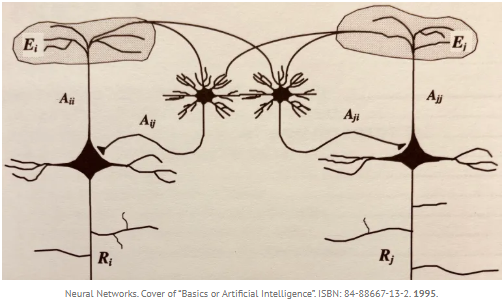
The Difference Today: We Have the Tech
Back then, the theory was already there—the dreams were maturing. What we were missing was the technology. Now, we finally have it.
AI isn’t a concept anymore; it’s a working tool. And it’s changing how we diagnose, operate, and care for patients every day. How AI Is Already Helping Doctors? Just a taste of it:
Back to Asimov
In October 2020, the first post of headneckroboticsurgery.com, “A little bit of history“,ended with an epilogue entitled “back to Asimov“:
What we are using now are not real robots… surgery still eludes real robotization… our devices are not smart enough yet.
Now, just a few years later, they are.
In less than another five years from now, you may not recognize our hospitals. AI is already reshaping them—let’s make sure it does so for good.
Staying behind is not an option.
J Granell. October 19, 2025