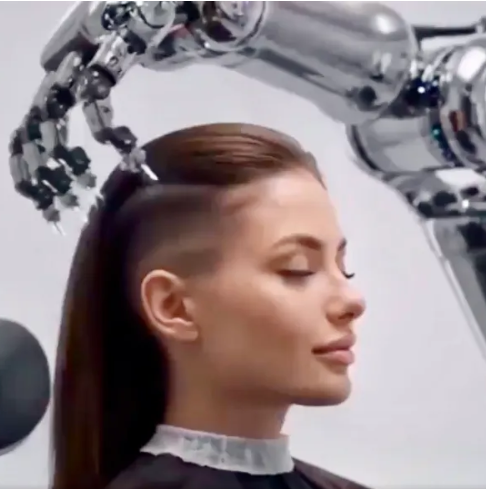
At first glance, it feels playful — a barber arm trimming hair with mechanical precision. But the question is deeper than it seems. If we are moving towards autonomous robotic surgery in the head and neck, where life, function, and identity are at stake… then why not a haircut?
The truth is, the barrier isn’t the technology itself, we are not far from it. It’s trust and safety. A haircut gone wrong is inconvenient. A surgery gone wrong is life-changing. That’s why Asimov’s first law — a robot may not harm a human — remains as relevant as ever.
But there is something interesting here: both a haircut and certain parts or surgical procedures are highly standardizable and repeatable. That makes them particularly suitable for robotization. Once the process is mastered, it can be reproduced in series with consistency — something machines excel at.
For robotics in surgery to move from assisted tools to autonomous operators, three things must align:
Safety must be demonstrable, not assumed.
Performance must be at least competitive with expert surgeons.
Acceptance must come from patients and professionals alike.
The video may be fiction, but it forces us to reflect: if society hesitates to trust a robot with a haircut, how ready are we to trust one with a pharyngectomy or a thyroidectomy?
The future of robotics in the head and neck will depend not only on engineering, but on ethics, transparency, and above all, patient safety.