
WELCOME TO HEAD & NECK ROBOTIC SURGERY
Advancing minimally invasive surgery with cutting-edge robotic systems for safer, faster, and more effective treatments.
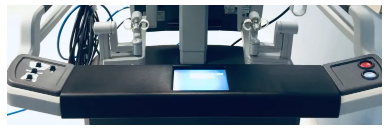
This evening, I attended an “academic meeting” on “AI and medicine”. The focus? How artificial intelligence might reshape medical practice and the age-old question: Can a robot replace a doctor or a surgeon?
Let’s be real. That’s not the right question anymore. AI isn’t just going to change medicine—it already has. The debate over whether humans can compete with machines is outdated.
Think back to 1997, when IBM’s Deep Blue defeated Garry Kasparov, the reigning chess world champion. Now, imagine the exponential advancements in technology since then. The world has moved on—have we? Look around. AI isn’t science fiction; it’s our present reality.
When it comes to the pillars of patient care—expertise and knowledge—AI is already setting the benchmark. Humans cannot match the speed, precision, and data-processing capabilities of machines. Artificial intelligence is not just about automating tasks; it’s about reasoning, problem-solving, and continuous learning through vast datasets. Machine learning, a subset of AI, refines this process further. By analyzing historical data and recognizing patterns, it enhances decision-making and improves outcomes over time. In medicine, this means faster diagnoses, personalized treatments, and an unparalleled ability to process complex information.
The question isn’t whether AI will replace doctors—it’s how doctors will work with AI to provide the best care possible. The future of medicine isn’t human or machine—it’s both.
The cutting edge of surgical robotics is no longer about programming every movement, but about machines learning from us? Enter the Surgical Robot Transformer, a groundbreaking joint research initiative from Johns Hopkins University and Stanford University.
This project uses imitation learning to train a da Vinci surgical system—not with painstakingly coded kinematics or measurements—but by observing a massive database of real surgical procedures. The result? A machine that can autonomously mimic complex surgical tasks. This isn’t just machine automation; it’s machine learning in its truest sense.
Now ask yourself: how long do you think it will take for these capabilities to be fully integrated into real-world surgical procedures? With machines already demonstrating a level of precision that humans simply can’t match, it’s only a matter of time.
The future of surgery isn’t about whether a surgeon can outperform a robot—because they can’t. It’s about how surgeons and medical professionals will adapt to a world where AI and robotics are integral parts of the operating room (it is ridiculous to attemp the oposite and try to set them in the old schemes).
We need to prepare ourselves for this rapid evolution. The pace of innovation in AI and robotics is accelerating exponentially, and the medical field is no exception (actually, it is one of its cutting edges). The question is: are we ready to guide these developments responsibly?
Because one thing is certain—this isn’t a slow revolution. It’s happening now, and it’s moving fast.
J Granell. Nov 21, 2024.