


The lingual artery represents a main concern in transoral surgery on the base of the tongue. There is a significant body of literature focusing on its management, including its management in TORS (refer to the list of references bellow). Successful handling of this critical aspect requires a comprehensive understanding of the anatomy and relevant anatomical landmarks. However, the variability of anatomical landmarks due to soft tissue movement poses a considerable challenge during surgical procedures.
Typically, the lingual artery can be located «down and lateral» in a transoral base of the tongue resection. Anatomic useful landmarks are the hyoid bone and the the transition between the base of the tongue and the vallecula. From the transoral point of view it will present itself as a loop (see the figure up left: cadaveric TORS dissection of the left lingual artery).
Depending of the depth of the dissection it will be or will not exposed. During the resection of the lingual tonsil, where dissection is carried out between the tonsil and the muscle, smaller arteries are expected. For a resection including muscle, encountering it depends on the depth of the dissection. In this situation, usually the dorsal lingual artery, arising from the loop of the lingual artery, needs to be ligated (see the figure up right: lingual dorsal artery arising from the loop of the lingual artery towards the base of the tongue specimen intended for resection in a cadaveric dissection). In a clinical situation, the lingual artery might or might not be encountered, so careful dissection should be performed at the danger zone.
If the lingual artery is exposed or damaged, it needs to be ligated with the utmost care to prevent postoperative bleeding, as it could lead to catastrophic consequences. To address this Weinstein recommends the use of what he calls the «titanium necklace», that is, securing the artery with multiple titanium vascular clips (see the figure bellow).
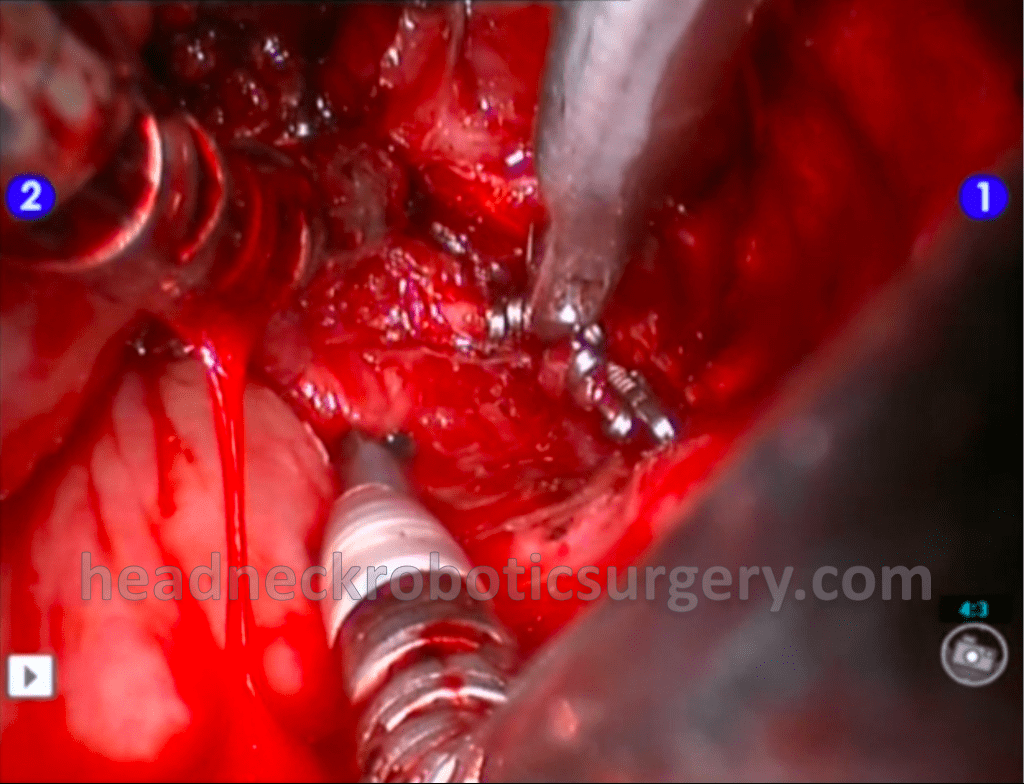
From the very beginning it was clear that one of the contributions of TORS was to the maintenance of hemostasis. Just look at the early papers on preclinical investigations by Hockstein, Weinstein and O´Malley: «The lingual artery as well as small arteries and veins were easily controlled and there were no difficulties with maintenance of hemostasis«
References
- Gun R, Durmus K, Carrau RL, Ozer E. The Course of Lingual Artery from Transoral Robotic View (letter). Head Neck. 2015 Mar;37(3):460-1. doi: 10.1002/hed.23852.
- Cohen DS, Mutchnick SA, Waxman JA, Patel S, Low GM, Melkane AE, Shkoukani MA, Lin HS. Establishing a danger zone: An anatomic study of the lingual artery in base of tongue surgery. Laryngoscope 2017 Jan;127(1):110-115. doi: 10.1002/lary.26048.
- Rao VUS, Subash A, R Bhargavi V, Sinha P, Bagadia RK, Kudpaje A, Arakeri G, Subbanna I. Selective embolization of lingual artery in transoral robotic surgery for the management of recurrent base of tongue carcinomas. Head Neck 2021 Apr;43(4):1174-1183. doi: 10.1002/hed.26585.
- Gualtieri T, Verzeletti V, Ferrari M, Perotti P, Morello R, Taboni S, Palumbo G, Ravanelli M, Rampinelli V, Mattavelli D, Paderno A, Buffoli B, Rodella LF, Nicolai P, Deganello A. A new landmark for lingual artery identification during transoral surgery: Anatomic-radiologic study. Head Neck 2021 May;43(5):1487-1498. doi: 10.1002/hed.26606.
- Dunlap Q, Mitchell WM, Gardner JR, King D, Samant R, Moreno M, Vural E. Vascularity Outcomes of Lingual Artery Ligation in Transoral Robotic Base of Tongue Resections. Otolaryngol Head Neck Surg. 2022 Apr;166(4):684-687. doi: 10.1177/01945998211017446.
- Ostrowski P, Szczepanek E, Niemczyk K, Bonczar M, Michalczak M, Batko J, Krawczyk-Ożóg A, Wojciechowski W, Walocha J, Koziej M. A 3D map of the lingual artery-The perfect tool for transoral robotic surgeries on the base of tongue. Head Neck. 2023 Apr;45(4):872-881. doi: 10.1002/hed.27303.
- Hockstein NG, Weinstein GS, O’malley BW Jr. Maintenance of hemostasis in transoral robotic surgery. ORL J Otorhinolaryngol Relat Spec. 2005;67(4):220-4. doi: 10.1159/000088012.
J Granell. August 2023.