
WELCOME TO HEAD & NECK ROBOTIC SURGERY IN THE H&N
Lingual Thyroid overview
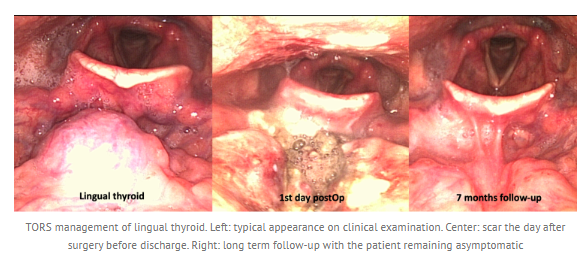
Lingual thyroid is the presence of ectopic thyroid glandular tissue at the base of the tongue, outside its typical anatomical location. During embryonic development, the thyroid gland’s precursor originates in the tongue and descends to its regular anatomical position in the lower neck, anterior to the larynx and the trachea. Various malformations can arise due to disruptions in this migration process. In certain instances, the glandular precursor travels a brief path, leading to thyroid tissue development within the thickness of the base of the tongue. Clinically, this often presents as a midline rounded mass, functionally behaving as an ectopic thyroid gland.
Symptomatology
In most patients with lingual thyroid, the thyroid gland is absent in its typical anatomical location, as the thyroid precursor completely ceases its migration within the tongue. The ectopic thyroid gland can be functional or non-functional, meaning it may or may not maintain adequate thyroid hormone secretion levels. If non-functional, patients exhibit hypothyroidism symptoms such as fatigue, cold intolerance, and dry skin. However, common symptoms primarily stem from the mass effect, contingent on the lesion’s volume. These symptoms range from a vague foreign body sensation in the pharynx to difficulties in swallowing or speech articulation and, in severe cases, substantial obstruction of the upper airway. Additionally, the highly vascular nature of thyroid tissue can lead to erosions on the surface, causing recurrent bleeding.
Diagnosis
Diagnosis can be strongly suspected through clinical examination. The characteristic appearance includes a reddish midline mass at the base of the tongue visible during laryngoscopy. Utilizing an ultrasound in the clinic setting can confirm the absence of a typical thyroid gland in its anatomical location. Thyroid function can be assessed through a blood test measuring thyroid hormone levels. Further confirmation of functionality and lesion nature involves scintigraphy, often accompanied by morphological imaging like CT or MRI. In rare cases, a biopsy might be necessary.
Indications for Treatment
Despite being ectopic tissue, malignancy is exceedingly rare. The decision to treat depends on the presence of symptoms. Evaluating thyroid function is crucial before intervention. If thyroid function is normal and the lingual thyroid represents the only functional thyroid tissue, its removal would lead to hypothyroidism, necessitating lifelong hormone replacement therapy. Patients should be informed of this possibility. In cases where the patient is already diagnosed with hypothyroidism and is receiving hormonal treatment, managing the lingual thyroid does not alter this treatment plan. Treatment decisions are significantly influenced by symptom severity, ranging from mild discomfort to obstructive complications (e.g., potentially causing obstructive sleep apnea). In the former scenario, treatment depends on patient preference; however, in severe cases, intervention is highly recommended due to the risk of potentially serious complications.
Treatment Options
In select cases requiring treatment, a conservative approach may involve thyroxine administration to suppress thyroid-stimulating hormone (TSH), aiding in volume control, or ablative therapy using radioiodine. Nevertheless, surgical excision remains the standard treatment. Traditional surgical methods encompass various open approaches, either transmandibular (involving a lip incision and mandibular section) or transcervical, all of which necessitate temporary tracheostomy. Minimally invasive transoral approaches employing conventional instruments, such as transoral laser microsurgery or different types of transoral endoscopic instrumentation, pose technical challenges in manipulating tissues in this anatomical location.
Transoral Robotic Surgery (TORS) has revolutionized minimally invasive surgical management of oropharyngeal lesions, including those at the base of the tongue. TORS for lingual thyroid excision is an efficient technique performed in a safe anatomical region (midline). The procedure benefits from 3D endoscopic vision and articulated instruments with robotic telemanipulation, enhancing precision. Emphasis must be placed on ensuring safety during the procedure, particularly concerning hemostasis, as postoperative bleeding from the base of the tongue can be perilous. However, the likelihood of severe complications with this technique remains very low. Typically, patients are observed overnight, resume oral intake the next day, and are discharged thereafter.
J Granell. October, 2023
Some references on TORS management of lingual thyroid
Park YM, Kim WS, Byeon HK, Lee SY, Kim SH. A novel technique for the resection of the symptomatic lingual thyroid: transoral robotic surgery. Thyroid. 2013;23: 466-471. doi: 10.1089/thy.2012.0292.
Howard BE, Moore EJ, Hinni ML. Lingual thyroidectomy: the Mayo clinic experience with transoral laser microsurgery and transoral robotic surgery. Ann Otol Rhinol Laryngol. 2014;123:183-187. doi: 10.1177/0003489414522976.
Ersoy Callıoglu E, Bozdemir K, Ulusoy B, Oguzhan T, Korkmaz MH. Lingual Thyroid Excision with Transoral Robotic Surgery. Case Rep Otolaryngol. 2015;2015:548582. doi: 10.1155/2015/548582.
Vincent A, Jategaonkar A, Kadakia S, Ducic Y. TORS excision of lingual thyroid carcinoma: Technique and systematic review. Am J Otolaryngol. 2019 May-Jun;40(3):435-439. doi: 10.1016/j.amjoto.2019.02.013
Filarski CF, Levine B, Buttan A, Gonzalez NR, Ho AS. Enlarged hemorrhagic lingual thyroid managed with transoral robotic surgery. Endocrine. 2021 Jun;72(3):923-927. doi: 10.1007/s12020-020-02586-w.
D’Andréa G, Vairel B, Vandersteen C, Chabrillac E, Vergez S, Bonnecaze G. Is Transoral Robotic Surgery the Best Surgical Treatment for Lingual Thyroid? A Case-Report and Literature Review. Ann Otol Rhinol Laryngol. 2022 Jan;131(1):39-51. doi: 10.1177/00034894211007251
Curtis J, Walford S, Howe D. Transoral robotic resection of a lingual thyroid: a novel treatment for obstructive sleep apnoea. BMJ Case Rep. 2021 Sep 16;14(9):e241412. doi: 10.1136/bcr-2020-241412
Check open surgery alternative (free full text on PMC)
Kumar LK, Kurien NM, Jacob MM, Menon PV, Khalam SA. Lingual thyroid. Ann Maxillofac Surg. 2015 Jan-Jun;5(1):104-7. doi: 10.4103/2231-0746.161103.
… please, don´t if you can opt for minimal access surgery.