
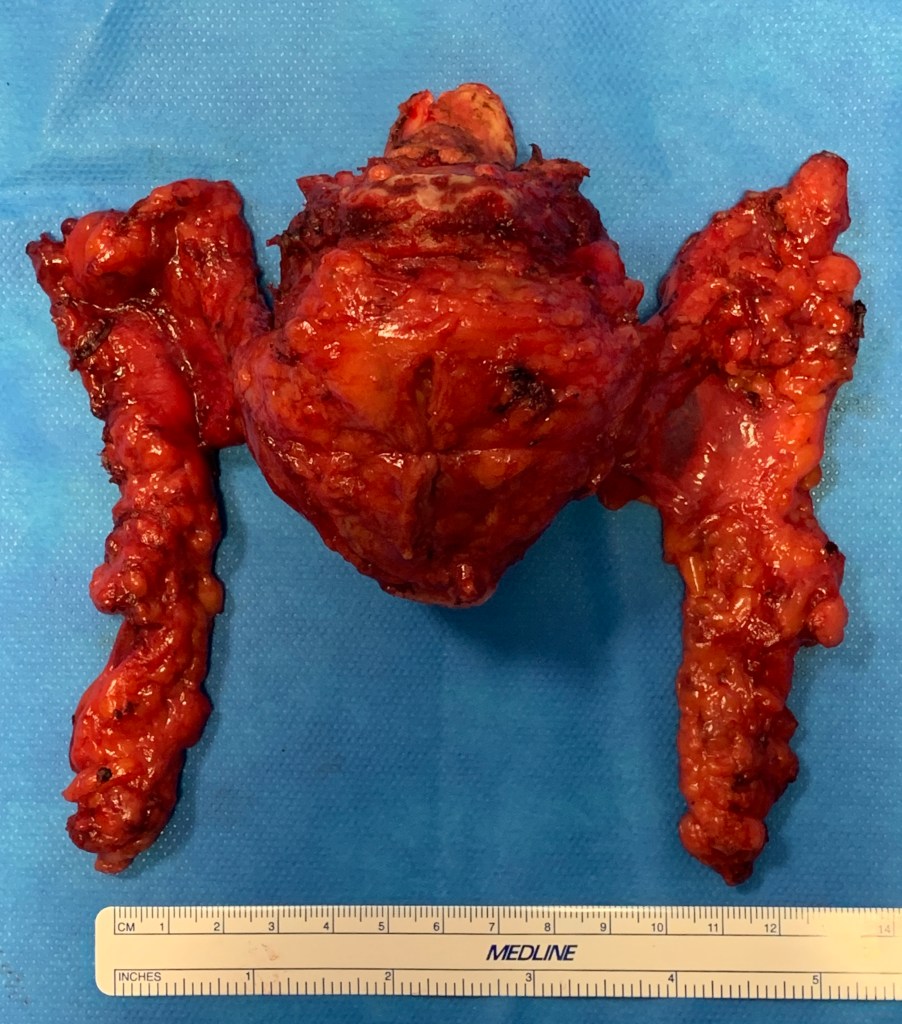

The common justification for performing a total laryngectomy is a T4a (TNM 8th edition) laryngeal cancer, where the tumor has infiltrated through the thyroid cartilage and involved the pre-laryngeal muscles, necessitating its removal in the oncologic resection. The procedure also mandates a bilateral neck dissection. Given the nature of this surgery an open approach is required, with minimal approach or functional surgery concepts not taken into account (excluding functional rehabilitation post total laryngectomy, which is separate consideration).
In year 2012 Georges Lawson and colleagues. published the technique for transoral robotic total laryngectomy in the «How I do it» section of The Laryngoscope1. It was one of the most downloaded papers of this high impact journal. The procedure was performed with the da Vinci S surgical system.
This technique is inherently hybrid, as it involves a tracheostomy and consequently necessitates a cervical incision and a cervical surgical time. Nonetheless, the technique enables minimal disturbance to the cervical tissues and a maximal mucosal preservation, theoretically leading to a smoother postoperative recovery and potentially reducing the occurrence of pharyngocutaneous fistulas.
It´s worth noting that transoral total laryngectomy con also be performed without robotic assistance2 and has also been demonstrated with the Versius Surgical System3.
This raises a debate on the required technology4, but the feasibility of the technique itself is established.
The challenge lies in identifying the suitable patient population for this technique. Clearly, it´s not suitable for T4a cases, and the majority of T3 will not get a total laryngectomy, but will go for radiochemotherapy. Therefore, indications are limited. Departments with experience encounter very few instances in salvage surgery and cases involving dysfunctional larynx conditions. Given the scarcity of cases across various patient profiles it´s challenging to definitely demonstrate medical benefits.
More than a decade after its initial implementation, this topic continues to be a subject of ongoing debate.
J Granell. August 2023.
1Lawson G, Mendelsohn AH, Van Der Vorst S, Bachy V, Remacle M. Transoral robotic surgery total laryngectomy. Laryngoscope 2013 Jan;123(1):193-6. doi: 10.1002/lary.23287.
2Fernández-Fernández MM, González LM, Calvo CR, Arias PP, Cabré FC, Del Álamo PO. Transoral ultrasonic total laryngectomy (TOUSS-TL): description of a new endoscopic approach and report of two cases. Eur Arch Otorhinolaryngol. 2016 Sep;273(9):2689-96. doi: 10.1007/s00405-015-3784-5.
3Funk E, Goldenberg D, Goyal N. Demonstration of transoral robotic supraglottic laryngectomy and total laryngectomy in cadaveric specimens using the Medrobotics Flex System. Head Neck. 2017 Jun;39(6):1218-1225. doi: 10.1002/hed.24746. Epub 2017 Mar 16. PMID: 28301093
4Granell J, Fernandez-Fernandez M, Gutierrez-Fonseca R. Letter to the Editor regarding «Robotic or non-robotic transoral laryngectomy«. Head Neck. 2018 Jan;40(1):213. doi: 10.1002/hed.25006.